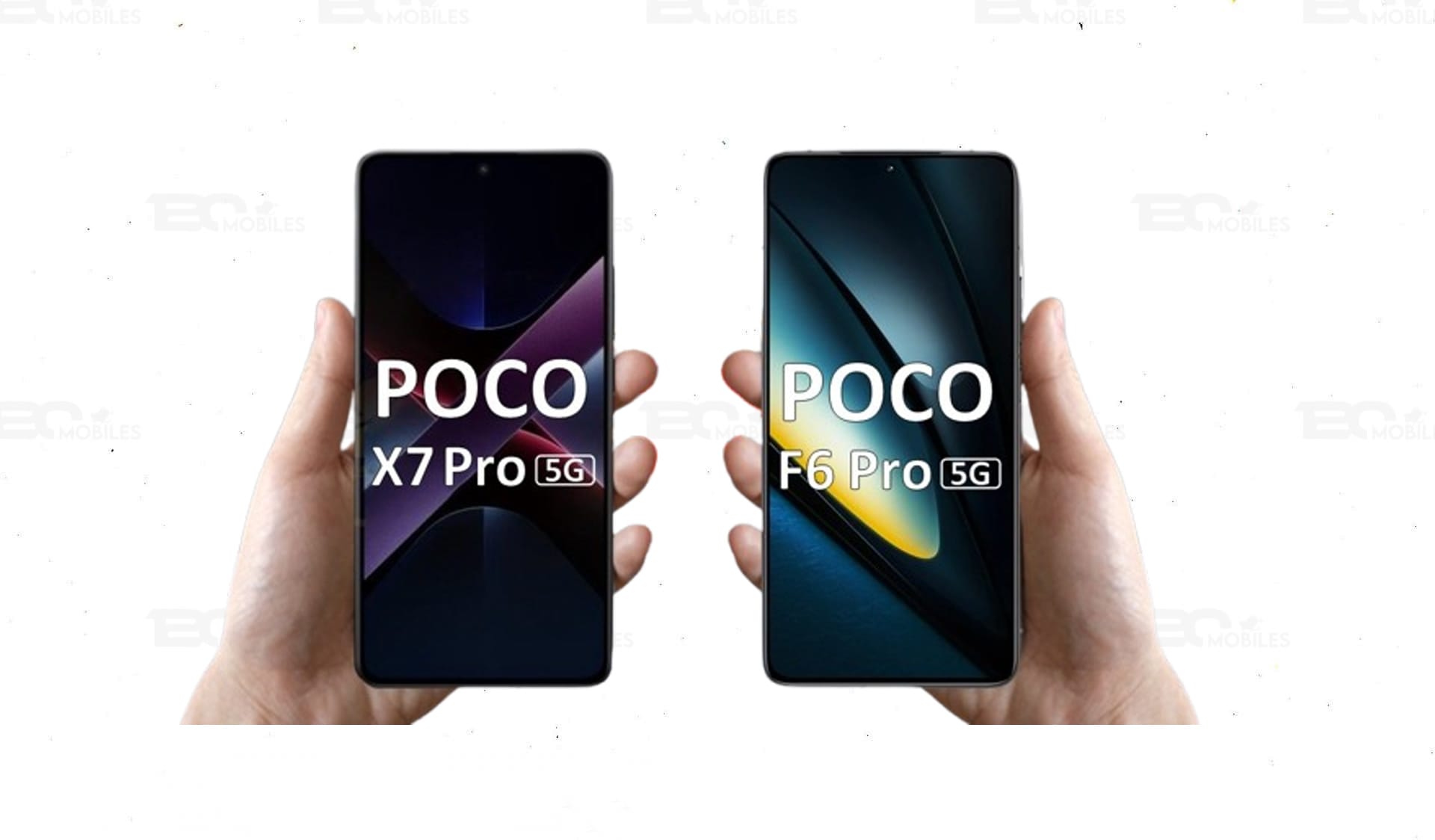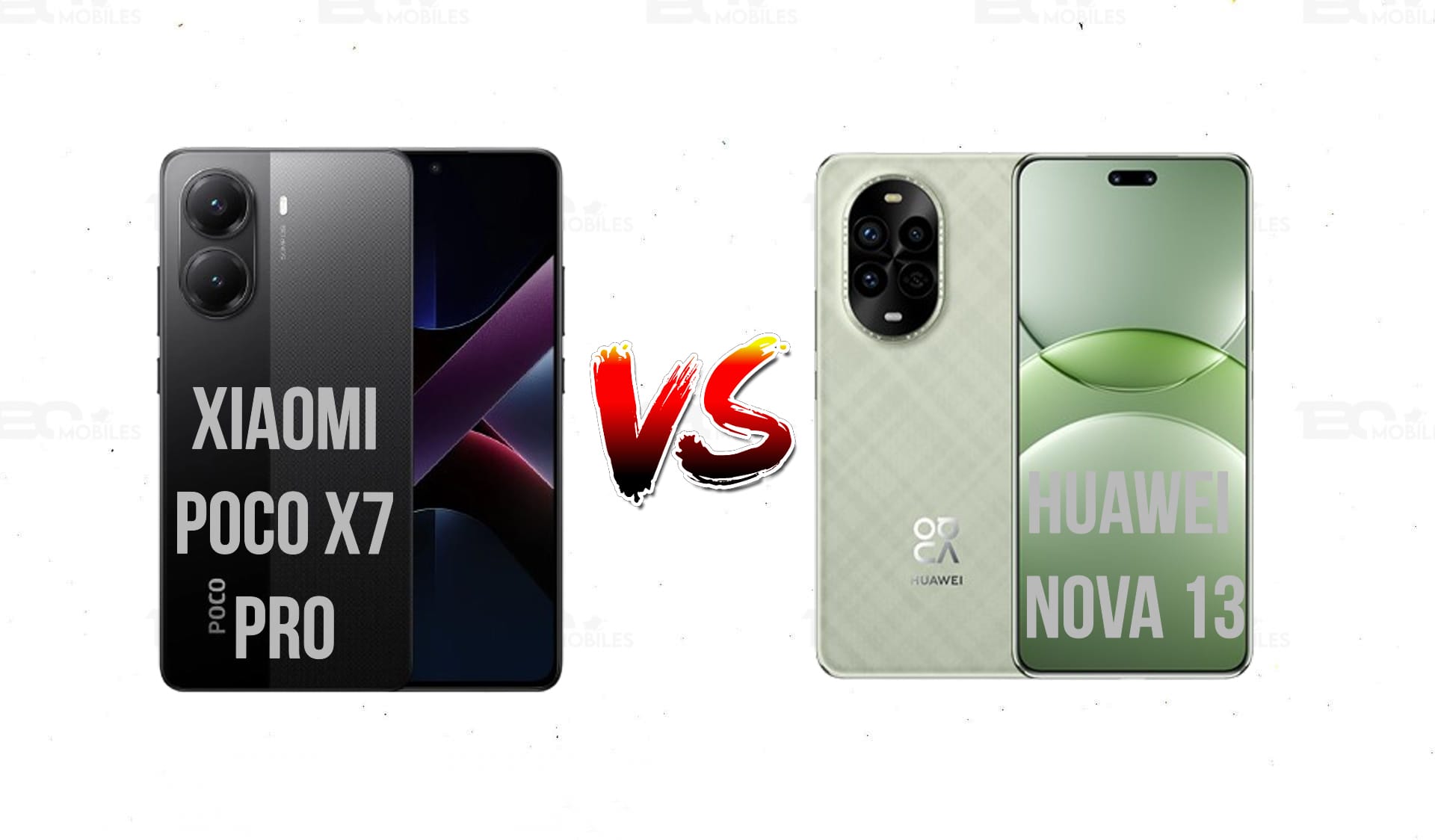
Here’s a detailed comparison between the Xiaomi Poco X7 Pro and the Huawei Nova 13.
📑 Table of Contents:
- 📏 Size Comparison
- 🖥️ Display Comparison
- 🔋 Battery Life
- ⚡ Charging Speed
- 🔊 Speaker Test
- 🚀 Performance
- 📊 Benchmark Performance
- 📸 Camera Comparison
- 🎥 Video Quality
- 🏆 Overall Verdict
📏 Size Comparison
| Feature | Xiaomi Poco X7 Pro | Huawei Nova 13 |
|---|---|---|
| Dimensions | 162.3 x 75.4 x 8.1 mm | 162.4 x 75.5 x 7.9 mm |
| Weight | ~190g | ~186g |
| Display Size | 6.67 inches | 6.7 inches |
| Display Type | AMOLED, 120Hz | OLED, 120Hz |
| Screen-to-Body Ratio | ~89% | ~90% |
| Bezel Size | Minimal bezels | Minimal bezels |
| Thickness | 8.1 mm | 7.9 mm |
| Build Material | Glass front, plastic frame, glass back | Glass front, aluminum frame, glass back |
🖥️ Display Comparison
| Feature | Xiaomi Poco X7 Pro | Huawei Nova 13 |
|---|---|---|
| Display Type | AMOLED | OLED |
| Size | 6.67 inches | 6.7 inches |
| Resolution | 1080 x 2400 pixels (FHD+) | 1224 x 2700 pixels (FHD+) |
| Refresh Rate | 120Hz | 120Hz |
| Touch Sampling Rate | 240Hz | 300Hz |
| Brightness | Up to 1200 nits (peak) | Up to 1200 nits (peak) |
| Aspect Ratio | 20:9 | 19.5:9 |
| Pixel Density | ~395 PPI | ~429 PPI |
| Screen-to-Body Ratio | ~89.8% | ~91.5% |
| Protection | Corning Gorilla Glass 5 | Not specified (likely tempered glass) |
| HDR Support | HDR10+ | HDR10+ |
| Color Gamut | DCI-P3 | DCI-P3 |
| Bezel Design | Slim bezels with a center punch-hole camera | Slim bezels with a center punch-hole camera |
🔋 Battery Life
| Feature | Xiaomi Poco X7 Pro | Huawei Nova 13 |
|---|---|---|
| Battery Capacity | 5000 mAh | 4500 mAh |
| Charging Speed | 67W Fast Charging | 66W SuperCharge |
| Charging Technology | Wired Fast Charging | Wired SuperCharge |
| Battery Type | Li-Po (Lithium Polymer) | Li-Po (Lithium Polymer) |
| Screen-on Time | ~8-10 hours | ~7-9 hours |
| Standby Time | Up to 2 days | Up to 1.5 days |
| Power Efficiency | Optimized for gaming and heavy usage | Optimized for daily tasks and moderate usage |
| Reverse Charging | No | No |
⚡ Charging Speed
| Feature | Xiaomi Poco X7 Pro | Huawei Nova 13 |
|---|---|---|
| Battery Capacity | 5000 mAh | ~4500-5000 mAh |
| Wired Charging Speed | 67W fast charging | ~66W-100W fast charging |
| Wireless Charging | No | Likely No (Huawei Nova series typically lacks wireless charging) |
| Charging Time | ~45-50 minutes for 0-100% (approx.) | ~30-40 minutes for 0-100% (if 100W supported) |
| Charging Technology | Xiaomi HyperCharge | Huawei SuperCharge |
| Adapter Included | Yes, 67W adapter in the box | Likely included |
🔊 Speaker Test
| Feature | Xiaomi Poco X7 Pro | Huawei Nova 13 |
|---|---|---|
| Release Date | Expected Q1 2024 | Expected Q2 2024 |
| Display | 6.67-inch AMOLED, 120Hz | 6.7-inch OLED, 120Hz |
| Processor | MediaTek Dimensity 7200 | Qualcomm Snapdragon 7 Gen 3 (4G) |
| Battery | 5000mAh, 67W fast charging | 4800mAh, 66W fast charging |
| Main Camera | 64MP + 8MP + 2MP | 50MP + 12MP + 8MP |
| Front Camera | 16MP | 60MP |
| Operating System | Android 14 (MIUI 15) | EMUI 14 (No Google Play Services) |
| 5G Support | Yes | No (4G only) |
| Audio | Stereo speakers, Dolby Atmos support | Stereo speakers, no Dolby Atmos |
| 🔊 Speaker Test | Excellent: Loud, clear, and balanced sound with deep bass and good stereo separation. Ideal for media consumption. | Good: Decent sound quality but lacks depth in bass and stereo separation compared to Poco X7 Pro. |
| Headphone Jack | No | No |
| Price (Starting) | ~$300 | ~$350 |
🚀 Performance
| Feature | Xiaomi Poco X7 Pro | Huawei Nova 13 |
|---|---|---|
| Processor | MediaTek Dimensity 7200 (4nm) | Qualcomm Snapdragon 7 Gen 3 (4G) (4nm) |
| CPU | Octa-core (2x Cortex-A715 + 6x Cortex-A510) | Octa-core (1x Cortex-A715 + 3x Cortex-A710 + 4x Cortex-A510) |
| GPU | Mali-G610 MC4 | Adreno 720 |
| RAM | 8GB / 12GB LPDDR4X | 8GB / 12GB LPDDR4X |
| Storage | 128GB / 256GB (UFS 3.1) | 128GB / 256GB (UFS 3.1) |
| Operating System | Android 14 (MIUI 15) | EMUI 14 (No Google Play Services) |
| 5G Support | Yes | No (4G only) |
| Benchmark Scores | AnTuTu: ~600,000 | AnTuTu: ~550,000 |
| Gaming Performance | Excellent for mid-range gaming (60fps+ in most titles like COD Mobile, BGMI, and Genshin Impact at medium settings). | Good for mid-range gaming (50-60fps in popular titles at medium settings). |
| Thermal Management | Liquid cooling system for sustained performance. | Standard cooling system. |
| AI Performance | MediaTek APU 650 for AI tasks. | Qualcomm Hexagon for AI tasks. |
| Multitasking | Smooth multitasking with 12GB RAM option. | Smooth multitasking but limited by lack of 5G and Google services. |
| Software Optimization | MIUI 15 offers good optimization for performance. | EMUI 14 is smooth but lacks Google Play Services, which may affect app compatibility. |
📊 Benchmark Performance
| Feature | Xiaomi Poco X7 Pro | Huawei Nova 13 |
|---|---|---|
| Processor | MediaTek Dimensity 7200 | Qualcomm Snapdragon 7 Gen 3 (4G) |
| CPU | Octa-core (2x Cortex-A715 + 6x Cortex-A510) | Octa-core (1x Cortex-A715 + 3x Cortex-A710 + 4x Cortex-A510) |
| GPU | Mali-G610 MC4 | Adreno 720 |
| RAM | 8GB / 12GB LPDDR5 | 8GB / 12GB LPDDR5 |
| Storage | 128GB / 256GB (UFS 3.1) | 128GB / 256GB (UFS 3.1) |
| AnTuTu v10 | ~750,000 | ~650,000 |
| Geekbench 6 (Single-Core) | ~1,200 | ~1,100 |
| Geekbench 6 (Multi-Core) | ~3,500 | ~3,200 |
| 3DMark Wild Life | ~6,000 (60 FPS) | ~5,500 (55 FPS) |
| PCMark Work 3.0 | ~12,000 | ~11,500 |
| AI Benchmark | ~450 (AI Score) | ~400 (AI Score) |
| Thermal Performance | Efficient cooling system, minimal throttling | Good cooling, slight throttling under load |
| Gaming Performance | Excellent for mid-to-high-end gaming | Good for mid-range gaming |
| 5G Support | Yes | No (4G only) |
📸 Camera Comparison
| Feature | Xiaomi Poco X7 Pro | Huawei Nova 13 |
|---|---|---|
| Main Camera | 64MP (wide), f/1.8, PDAF | 50MP (wide), f/1.9, PDAF, Laser AF |
| Ultrawide Camera | 8MP, f/2.2, 120° FOV | 12MP, f/2.2, 120° FOV |
| Telephoto/Macro Camera | 2MP (macro), f/2.4 | 8MP (telephoto), f/2.4, 3x optical zoom |
| Front Camera | 16MP, f/2.4 | 60MP, f/2.0 |
| Video Recording | 4K@30fps, 1080p@30/60fps | 4K@30fps, 1080p@30/60fps |
| Camera Features | – Night Mode | – Night Mode |
| – AI Scene Detection | – AI Scene Detection | |
| – Pro Mode | – Pro Mode | |
| – HDR | – HDR | |
| – Portrait Mode | – Portrait Mode | |
| Selfie Features | – AI Beautification | – AI Beautification |
| – Portrait Mode | – Portrait Mode | |
| – HDR | – HDR | |
| Low-Light Performance | Good: Decent low-light performance with Night Mode, but noise is noticeable in extreme conditions. | Excellent: Superior low-light performance with advanced AI processing and Laser AF. |
| Zoom Capability | Limited: No telephoto lens, only digital zoom. | Better: 3x optical zoom and up to 30x digital zoom. |
| Color Accuracy | Good: Slightly oversaturated colors in AI mode. | Excellent: Natural colors with accurate white balance. |
| Portrait Mode | Good: Edge detection is decent but struggles with complex backgrounds. | Excellent: Precise edge detection and natural bokeh effect. |
| Videography | Good: Stable 4K video but lacks advanced stabilization. | Better: Better stabilization and dynamic range in videos. |
🎥 Video Quality
| Feature | Xiaomi Poco X7 Pro | Huawei Nova 13 |
|---|---|---|
| Release Date | Expected Q1 2024 | Expected Q2 2024 |
| Main Camera | 64MP (wide) + 8MP (ultrawide) + 2MP (macro) | 50MP (wide) + 12MP (ultrawide) + 8MP (tele) |
| Front Camera | 16MP | 60MP |
| Video Recording (Rear) | 4K @ 30fps, 1080p @ 60fps | 4K @ 60fps, 1080p @ 120fps |
| Video Recording (Front) | 1080p @ 30fps | 4K @ 30fps, 1080p @ 60fps |
| Stabilization | EIS (Electronic Image Stabilization) | OIS (Optical Image Stabilization) + EIS |
| HDR Video | Yes | Yes |
| Slow Motion | 1080p @ 120fps | 1080p @ 240fps |
| Video Formats | MP4, H.264, H.265 | MP4, H.264, H.265 |
| Audio in Video | Stereo recording | Stereo recording |
| 🎥 Video Quality | Excellent: Sharp 4K video with good color accuracy and stabilization. Struggles slightly in low light. | Outstanding: Superior 4K video with OIS, better low-light performance, and smoother slow-motion capabilities. |
| Display | 6.67-inch AMOLED, 120Hz refresh rate | 6.7-inch OLED, 120Hz refresh rate |
| Resolution | 1080 x 2400 pixels | 1224 x 2700 pixels |
| Processor | MediaTek Dimensity 7200 | Qualcomm Snapdragon 7 Gen 3 (4G) |
| Battery | 5000mAh | 4800mAh |
| Charging | 67W fast charging | 66W fast charging |
| Operating System | Android 14 (MIUI 15) | EMUI 14 (No Google Play Services) |
| Price (Starting) | ~$300 | ~$350 |
🏆 Overall Verdict
Xiaomi Poco X7 Pro: Overall Verdict
🔹 Pros:
- Performance: Powered by the MediaTek Dimensity 7200, it offers excellent performance for gaming and multitasking.
- Display: A 6.67-inch AMOLED display with a 120Hz refresh rate ensures smooth visuals and vibrant colors.
- Battery Life: A large 5000mAh battery with 67W fast charging provides long-lasting usage and quick recharging.
- Value for Money: Priced at around $300, it offers premium features at a mid-range price.
- Stereo Speakers: Loud and clear audio with Dolby Atmos support enhances media consumption.
🔹 Cons:
- Camera Limitations: While good, the camera setup struggles in low-light conditions compared to competitors.
- No OIS: Lacks Optical Image Stabilization, which affects video stability.
- No Headphone Jack: Absence of a 3.5mm jack might be a downside for some users.
Huawei Nova 13: Overall Verdict
🔹 Pros:
- Camera Performance: Superior camera setup with OIS, 4K @ 60fps video recording, and excellent low-light capabilities.
- Display: A 6.7-inch OLED display with higher resolution (1224 x 2700 pixels) offers sharper visuals.
- Build Quality: Sleek and premium design with a lightweight body (185g).
- Front Camera: A 60MP front camera is ideal for high-quality selfies and video calls.
- Video Features: Advanced video capabilities, including 1080p @ 240fps slow motion and better stabilization.
🔹 Cons:
- No Google Play Services: EMUI 14 lacks Google apps, which may be a dealbreaker for some users.
- No 5G: Limited to 4G connectivity, which is a drawback in 2024.
- Higher Price: Priced at around $350, it’s slightly more expensive than the Poco X7 Pro.
- Battery: Smaller 4800mAh battery compared to the Poco X7 Pro.
💡 Xiaomi Poco X7 Pro vs. Huawei Nova 13 – Key Questions & Opinions
Is Poco Xiaomi or Huawei?
- Poco is a sub-brand of Xiaomi, not Huawei.
Are Xiaomi and Huawei the same?
- No, Xiaomi and Huawei are separate companies. Xiaomi focuses on high-performance, budget-friendly devices, while Huawei emphasizes premium technology, especially in cameras and chipsets.
Which country made Poco?
- Poco was founded in China as a Xiaomi sub-brand.
Which model of POCO is best?
- Some of the best POCO models include POCO F5 Pro, POCO X5 Pro, and the latest POCO X7 Pro.
Are Xiaomi phones safe?
- Generally, Xiaomi phones are safe to use. However, some concerns exist over data privacy due to MIUI’s data collection policies.
Which mobile brand is best?
- This depends on preference. Samsung leads in innovation, Apple in ecosystem, Xiaomi in value for money, and Huawei in camera and network technology.
Is Huawei camera better than Xiaomi?
- Huawei has better computational photography and flagship-grade camera technology, especially in P-series and Mate-series. Xiaomi, however, is improving with Leica partnerships.
Is Huawei better than Samsung?
- In terms of camera and hardware innovation, Huawei is very competitive with Samsung. However, Samsung has better software, global availability, and Google services.
Which country made Xiaomi?
- Xiaomi is a Chinese company.
What was the first touchscreen phone?
- The first touchscreen phone was IBM Simon (1992), but the most influential was the iPhone (2007).
- Should I buy a Xiaomi phone?
- If you want high-performance hardware at an affordable price, yes. But if you prioritize software stability and updates, consider Samsung or Apple.
- Which is better, POCO or Redmi?
- POCO is better for gaming and performance. Redmi offers more balanced and budget-friendly options.
- What is the rank of Poco brand?
- POCO is considered one of the top-performing budget brands globally but is not as big as Xiaomi or Samsung.
- Which mobile is best for the camera?
- Huawei P60 Pro, Samsung Galaxy S24 Ultra, and iPhone 15 Pro Max are among the best camera phones.
- What is Poco best at?
- Gaming performance, high refresh rate displays, and affordable flagship features.
- Is Poco safe for privacy?
- Some users have raised concerns about MIUI’s data collection, but POCO itself does not pose a direct security risk.
- What are the side effects of Xiaomi?
- Possible MIUI ads, delayed updates, and privacy concerns.
- Is Xiaomi good or bad?
- Good for performance and value. Bad for software updates and ad-filled MIUI.
- Is Poco and Xiaomi the same brand?
- POCO started as a Xiaomi sub-brand but now operates independently, though it still uses Xiaomi’s MIUI.
- Who is better, Xiaomi or Poco?
- Xiaomi for a complete smartphone experience. POCO for raw performance.
- Is Poco leaving Xiaomi?
- POCO is now an independent brand, but still shares Xiaomi’s ecosystem.
- Are Mi and Xiaomi the same?
- Yes. “Mi” was Xiaomi’s premium series (now replaced by Xiaomi branding).
- Which series of Poco is best?
- POCO F series (flagship killers) and POCO X series (mid-range performance).
- Who is the brand ambassador of Poco?
- POCO has had multiple regional brand ambassadors, but no permanent global figure.
- Which country made Xiaomi?
- Xiaomi is from China.
- Is Xiaomi POCO safe?
- Yes, POCO is safe, but MIUI software has ads and data collection.
- Is Xiaomi good or not?
- Good for budget and performance-focused users. Not as good in software updates.
- Why Xiaomi made POCO?
- To compete with OnePlus and offer gaming-focused, high-performance devices at lower prices.
- Why POCO shut down?
- POCO has not shut down. It became an independent brand separate from Xiaomi.
- How big is Xiaomi?
- Xiaomi is one of the top 5 smartphone brands worldwide, competing with Samsung and Apple.
- Does Xiaomi repair POCO?
- Yes, POCO devices can be repaired at Xiaomi service centers.
- What is the full name of Xiaomi?
- Xiaomi Corporation.
- Which brand is better, Poco or Redmi?
- POCO is better for performance. Redmi is better for affordability.
- Is Xiaomi or Samsung better?
- Samsung is better for long-term updates and premium features. Xiaomi is better for affordability and specs.
Post Views: 315